11 September 2026
Software Development RFP Template with 30%, 25%, 20%, 15%, 10% Scoring
A copy ready software development RFP aligned to the SRS, with a publishable scoring matrix (30%, 25%, 20%, 15%, 10%), timelines, budget guidance, and...
Software Development RFP Template with 30%, 25%, 20%, 15%, 10% Scoring
A software development RFP is a structured document you send to multiple vendors to get comparable, apples-to-apples bids on a defined project. Run one when the scope is real enough to compare against a scoring matrix, and you need to choose between several qualified teams; skip it for small, fast-moving projects where a curated quote service gets you vetted options in days instead of weeks.
TL;DR:
- A software development RFP should clearly define outcomes, scope, technical context, and team expectations to ensure vendors understand and answer consistently.
- The process typically takes several weeks, with a minimum two-week Q&A period; sharing a project budget range helps produce comparable proposals.
- Scoring proposals should focus on understanding of the problem, relevant experience, and realistic timelines, rather than just cost.
- Over-specifying solutions or rushing the Q&A window can lead to weak proposals and misaligned vendor responses.
- For small projects or fast timelines, curated quote platforms like 5quotes offer quick, vetted options, avoiding the overhead of a full RFP.
Table of Contents
- What Is a Software Development RFP and When Do You Need One?
- The RFP Template: What to Include and Why
- How Long Should an RFP Take, and What Budget Should You Share?
- How Do You Score and Compare Vendor Proposals?
- Mistakes That Sink RFP Responses Before They Start
- Why the SRS Still Matters After the RFP Is Won
- When a Full RFP Is Overkill
- How 5quotes Gets You Vendor Quotes Without the RFP Overhead
- Templates and Standards Worth Bookmarking
- Sources
- FAQ
What Is a Software Development RFP and When Do You Need One?
An RFP, or request for proposal, is how you formally ask software vendors to tell you what they’d build, how they’d build it, who’d build it, and what it would cost. It’s not a job posting and it’s not a casual “send me a quote” email. It’s a structured comparison tool, and its entire value depends on every vendor answering the same questions in a format you can actually line up side by side.
That’s different from a request for quote (RFQ), which assumes you already know exactly what you want and just need pricing. An RFP works better for software because most projects start with a business problem, not a finished specification. You’re asking vendors to help solve something, not just execute a known task.
You need one when you have real scope, a defined budget range, and enough internal clarity to evaluate technical approaches against each other. A practical RFP runs on seven core sections: company overview, scope framed as outcomes, technical context, engagement expectations, budget range, proposal requirements, and evaluation criteria. Skip the RFP process entirely if you’re hiring one freelancer for a two-week fix or if the project is small enough that a curated quote marketplace can surface qualified developers faster than a formal solicitation ever would.
The confusion between an RFP and a software requirements document, or SRS, trips up a lot of first-time buyers. An RFP asks vendors “how would you solve this and what would it cost?” An SRS defines “exactly what the finished system must do.” You write the RFP first to select a partner; the SRS gets built afterward, usually collaboratively, once that partner is on board.
The RFP Template: What to Include and Why
A vendor can’t give you a comparable bid if your RFP is vague about outcomes or silent on technical reality. Each section below exists to eliminate a specific kind of guesswork.
Company and project overview. State who you are, who the software serves, and what success looks like in measurable terms. Don’t just say “we need a customer portal.” Say “we need to cut support ticket volume by reducing manual account lookups,” and name the KPI you’ll track.
Project goals as outcomes, not features. List what the software needs to achieve before you list what it needs to do. “Reduce checkout abandonment” is an outcome. “Add a one-click checkout button” is a feature guess dressed up as a requirement, and it boxes vendors into your assumption instead of letting them propose a better one.
Scope, split into must-haves and optional items. Vendors need to know what’s non-negotiable versus what’s a stretch goal they can price separately. This is also where you list every integration by name (payment processors, CRMs, ERPs, third-party APIs) rather than a vague “must integrate with our existing systems.”
Technical context. Describe your current stack, hosting environment, security requirements, and any accessibility standards (WCAG 2.1, for example) you need met. This alone eliminates half the follow-up questions during Q&A.
Team expectations. Specify the seniority mix you expect, whether you need overlap with your working hours or timezone, and whether you want a dedicated team or a shared one.
Submission requirements. Spell out exactly what a complete proposal includes:
- Technical approach and architecture summary
- Team composition with relevant experience
- Timeline broken into milestones
- Pricing structure (fixed bid, time and materials, or hybrid)
- Three verifiable references or case studies
Contractual expectations. Note upfront how you’ll handle intellectual property ownership, payment milestones, and warranty periods, so nobody discovers a dealbreaker after they’ve already invested in writing a proposal.
How Long Should an RFP Take, and What Budget Should You Share?
A realistic RFP timeline runs several weeks from publication to signed contract, and rushing that window is one of the fastest ways to get thin, copy-paste proposals instead of thoughtful ones.
- Publish the RFP with a firm deadline for vendor questions, not just a submission date.
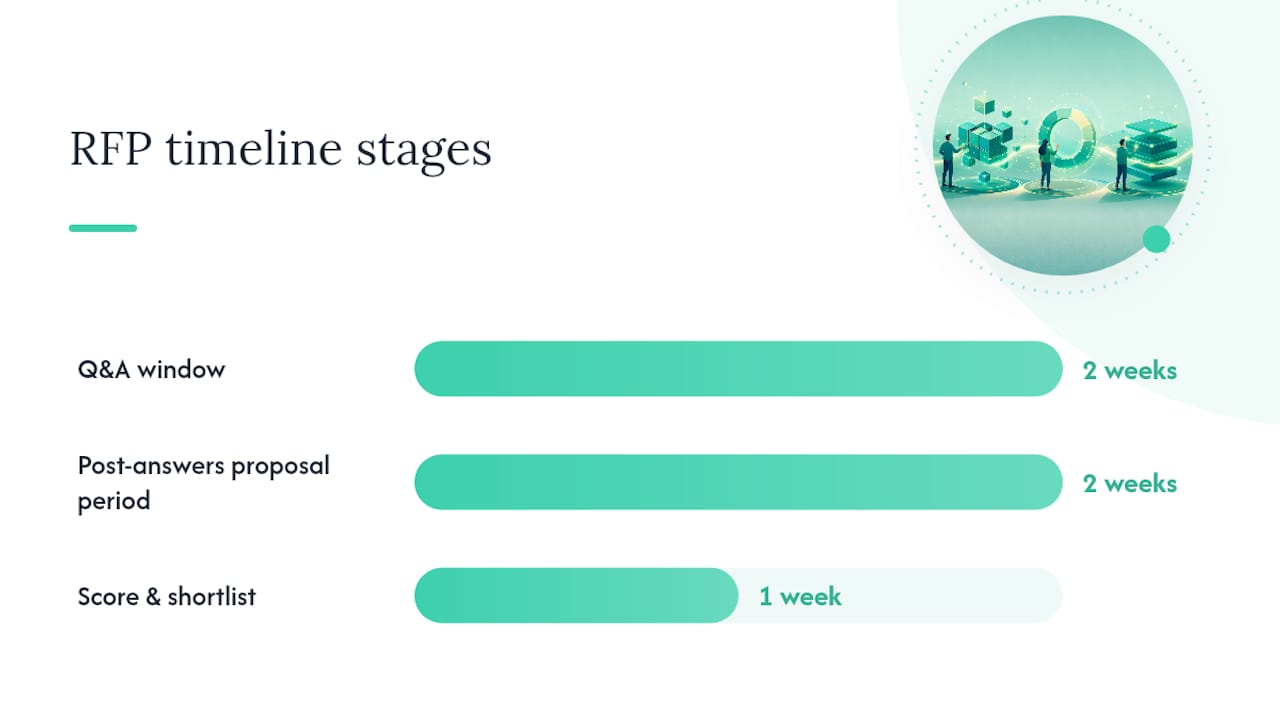
- Hold a two-week minimum Q&A window. Vendors need time to ask about your stack, your integrations, and your ambiguities before they can price anything responsibly.
- Give another two weeks after answers are published before proposals are due, since serious vendors revise their approach once they understand the full picture.
- Score and shortlist within a week of the deadline, while the comparisons are still fresh.
- Run demos or technical interviews with your top two or three vendors before signing anything.
Pro Tip: Compressing the Q&A window to save a week almost always costs you more time later, because vendors who didn’t get answers make assumptions, and those assumptions show up as change orders after the contract is signed.
On budget, share a range. Whether it’s “$80,000 to $120,000” or simply “mid five figures,” a budget signal keeps proposals in the same ballpark instead of forcing you to compare a $40,000 bid against a $300,000 one with no shared assumptions. Withholding your budget doesn’t protect you from overpaying; it just produces proposals you can’t meaningfully compare.
If your total project budget is under a certain threshold, the RFP process itself often costs more in staff hours than it saves in vendor selection quality. At that size, a faster path, like posting the project on a curated quote platform, usually gets you qualified options without the lengthy overhead.
How Do You Score and Compare Vendor Proposals?
The single most useful filter in proposal review is whether the vendor actually understood your problem. If they misread the business challenge, everything downstream, their proposed architecture, their timeline, their price, is built on a bad foundation. Read the “understanding of the problem” section before anything else, and score it hardest.
A weighted scoring matrix keeps that judgment from being purely a gut call. A commonly used weighting looks like this:
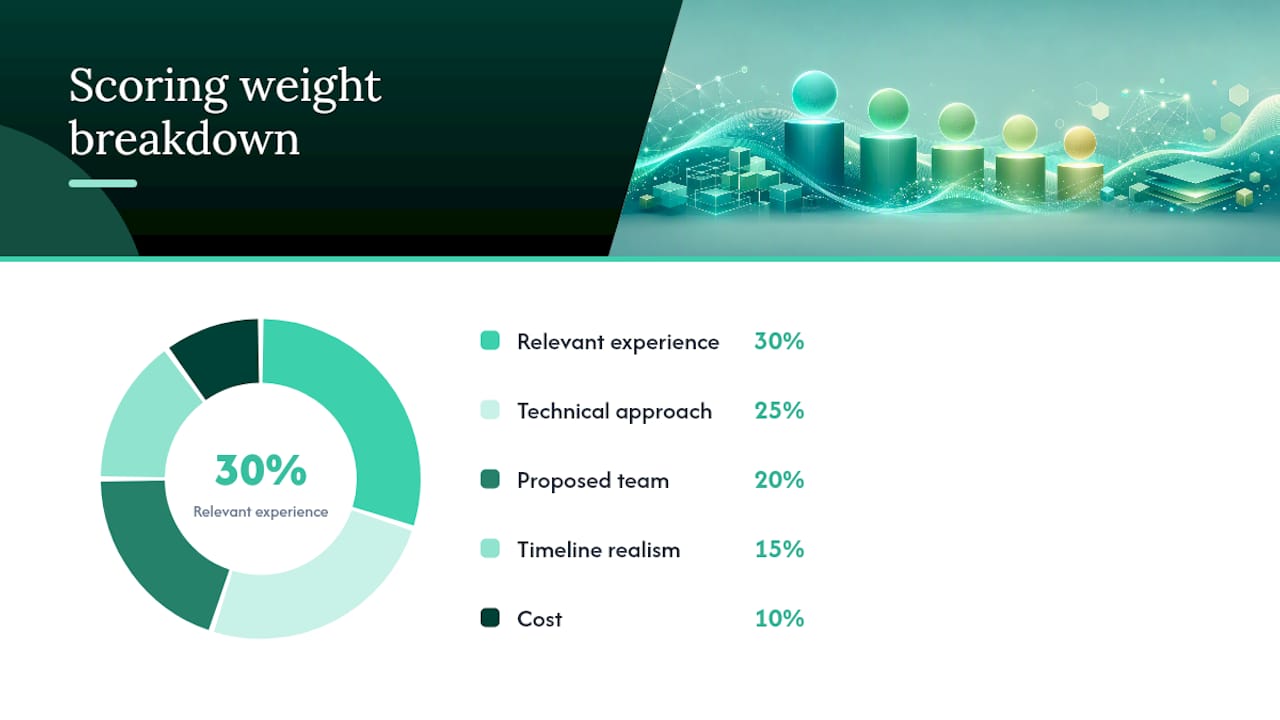
- Relevant experience: 30%, based on similar projects, not just years in business
- Technical approach: 25%, judged on whether it fits your actual constraints, not just whether it sounds sophisticated
- Proposed team: 20%, weighted toward the specific people assigned, not the company’s average talent
- Timeline realism: 15%, penalizing estimates that seem too fast for the stated scope
- Cost: 10%, deliberately weighted low because the cheapest bid is rarely the cheapest project once rework and delays are counted
Publishing these weights inside the RFP itself, rather than keeping them internal, tells vendors exactly what to emphasize and produces sharper, more relevant proposals.
Watch for red flags in the technical approach: generic architecture diagrams that could apply to any project, teams with no named senior members, or timelines that ignore your stated integrations. Call every reference. Ask specifically what went wrong on their project, not just what went right, and cross-check that the case studies match the technology you’re actually using.
Shortlist to two or three vendors maximum for a technical deep-dive or live demo before making a final call. Beyond three, the comparison quality drops and the process drags.
Mistakes That Sink RFP Responses Before They Start
Most weak RFP responses trace back to a handful of avoidable errors on the buyer’s side, not vendor incompetence.
- Over-specifying the solution. Treating software procurement like a commodity purchase and dictating exact technical implementation pushes away experienced vendors who’d otherwise propose a better approach, and it attracts the vendors willing to just build exactly what you asked, mistakes included.
- Under-explaining the business outcome. If vendors don’t know why the project matters, they can’t prioritize correctly when trade-offs come up mid-build.
- Withholding the budget. This doesn’t protect you; it just guarantees proposals spanning a 5x price range with no shared assumptions to compare.
- Compressing the Q&A window. A rushed timeline produces rushed, generic answers.
- Skipping acceptance criteria. Every requirement needs a clear definition of “done,” or you’ll be arguing about it at delivery.
Build a short checklist into your RFP distinguishing mandatory response items from optional ones, and state your assumptions plainly. Vendors respond better to clarity than to exhaustive detail.
Why the SRS Still Matters After the RFP Is Won
Winning the RFP doesn’t mean the requirements work is finished. It means it’s about to get precise. The Software Requirements Specification becomes the technical source of truth that design, testing, and acceptance all get measured against.
A solid SRS includes functional requirements, non-functional requirements like performance and security thresholds, and a traceability matrix linking each requirement to how it will be verified. NASA’s SRS guidance organizes requirements by Computer Software Configuration Items, or CSCIs, so nothing gets buried in a wall of undifferentiated text.
Write the SRS jointly with your selected vendor right after contract signing, and use its requirements directly as acceptance criteria in the contract itself.
When a Full RFP Is Overkill
A full RFP process makes sense when you’re comparing several vendors on real scope and need documented, defensible evaluation criteria, especially in procurement-sensitive environments. It’s overkill when you’re a small business or startup that just needs a handful of solid options fast.
Speed matters most for smaller projects, tight teams, or founders without a procurement department to run a six-week process. In those cases, a curated quote marketplace does the vendor legwork for you: you describe the project once, and vetted developers who fit the brief come to you instead of the reverse. The trade-off is real. You lose some of the granular, documented comparison an RFP produces, and you gain weeks of your time back plus a level of privacy an open solicitation can’t offer.
How 5quotes Gets You Vendor Quotes Without the RFP Overhead
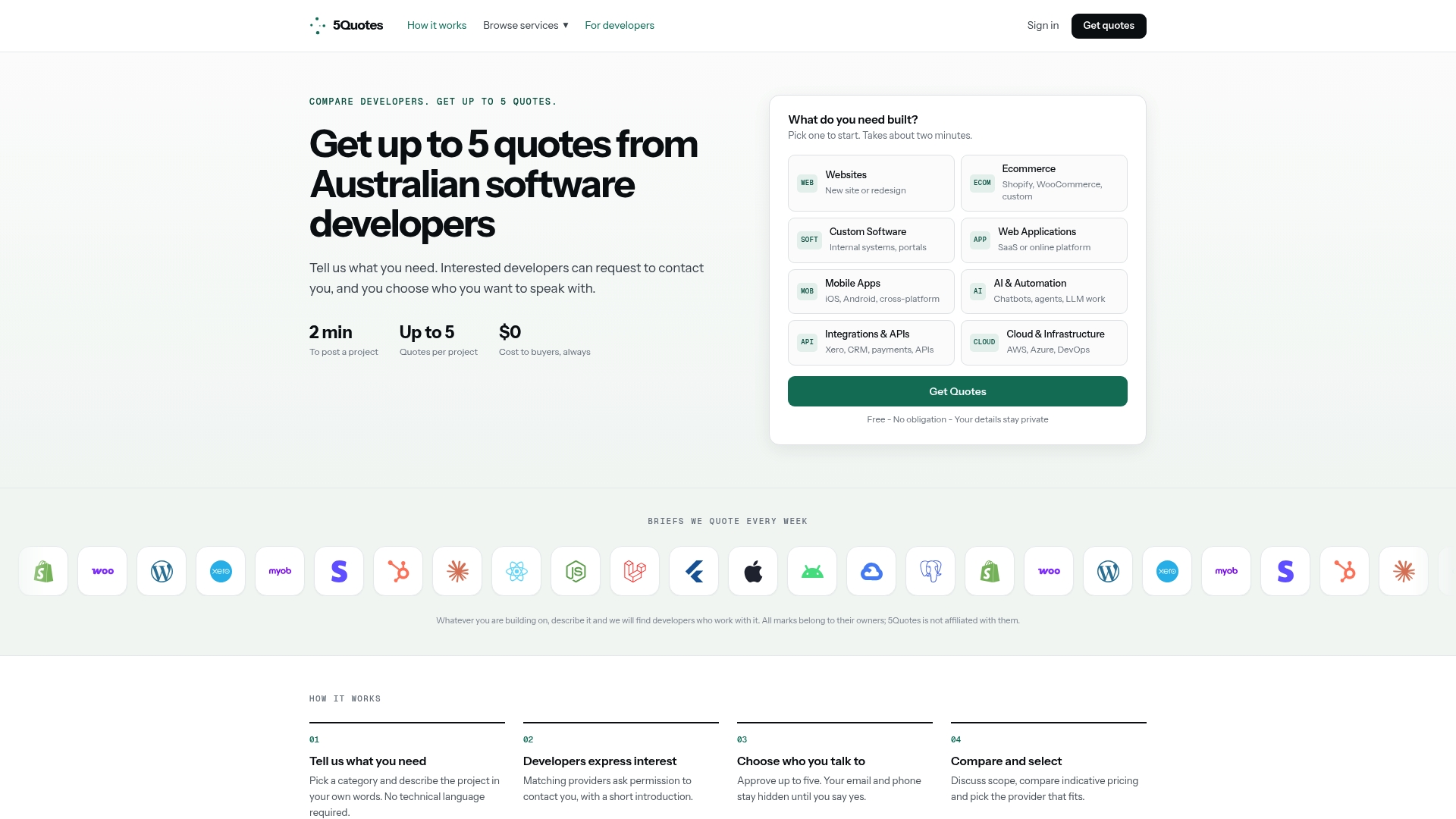
If a six-week RFP cycle isn’t worth it for your project, 5quotes is the faster route to the same outcome: qualified developers, compared side by side, without writing a formal solicitation. Post your project once, describe what you need, whether that’s a customer portal, a mobile app, or a custom integration, and receive several tailored quotes from vetted developers, not a flood of unsolicited outreach.
This works well for the projects too small to justify a full RFP: a $20,000 web app rebuild, a mobile app redesign, or a scoped integration project where you need real pricing fast rather than a formal evaluation matrix. Developers on such platforms typically go through vetting before they contact you, so you’re comparing legitimate proposals instead of sorting cold pitches. If your project fits that profile, get your five quotes and skip straight to comparing real bids.
Templates and Standards Worth Bookmarking
For the technical backbone of your requirements work, NASA’s SRS guidance lays out CSCI-based organization and traceability matrices in detail. For the RFP itself, Launch Day Advisors’ RFP guide and Madgeek’s RFP template both offer section-by-section structures you can adapt directly. Developers weighing AI-assisted documentation tools during onboarding may also find AmmarAI’s developer resources useful for structuring technical handoffs.
Sources
- Software Development RFP | Launch Day Advisors
- SRS - Software Requirements Specification | NASA SWEHB
- Software Development RFP Template: What to Include Before You Hire a Development Team | Madgeek
FAQ
What Is an RFP in Software Development?
It’s a structured document you send to multiple vendors asking how they’d approach your project, who’d build it, and what it would cost, so you can compare bids on equal footing rather than negotiating each one from scratch.
Can You Give an Example of a Software Development RFP?
A solid example follows seven sections: company overview, scope framed as outcomes, technical context, team expectations, timeline, budget range, and evaluation criteria, each explained in enough detail that vendors can respond without guessing.
What’s the Difference Between an RFQ and an RFP?
An RFQ (request for quote) assumes you already know exactly what you need and just want pricing; an RFP asks vendors to propose both the approach and the cost, which fits software projects where the solution isn’t fully defined yet.
What Is an RFP in the IT Industry Specifically?
In IT and software procurement, an RFP typically includes technical context like your current stack and integrations, alongside business goals, so vendors can propose a solution that fits your existing environment rather than a generic build.
Is a Full RFP Always Necessary for Software Projects?
No. Smaller projects or those needing developers quickly without a formal procurement cycle often do better with a curated quote service like 5quotes than with a multi-week RFP process.
Recommended
Read next
Getting this built?
Tell us what you need and compare up to 5 quotes from developers who do this work.
Get quotes