17 September 2026
Cut the 15% to 30% Premium: Fixed Price vs Hourly for New Zealand Teams
For New Zealand teams: choose discovery then fixed to cut the 15% to 30% hidden premium, spot padding in quotes, and negotiate clearer terms.
Cut the 15% to 30% Premium: Fixed Price vs Hourly for New Zealand Teams
Choose fixed price when scope is stable, small, and you need budget certainty. Choose hourly, formally called time and materials or T&M, when requirements are still moving or the work is exploratory. For most projects that aren’t trivially simple, the smartest move is a hybrid: a short, capped T&M discovery phase that produces a real spec, followed by a fixed-price build based on what that discovery uncovers.
TL;DR:
- Fixed price contracts include a 15% to 30% safety margin to cover unknowns, often hidden in the total bid unless explicitly itemized.
- Hourly or T&M projects require active oversight and may lead to billable drift if hours are not carefully monitored.
- Running a short discovery phase before fixed-price work clarifies scope, reduces uncertainty premiums, and can result in overall cost savings.
- Comparing at least five vendor quotes side by side is the fastest way to identify assumptions, padding, and realistic pricing for the project.
- A hybrid approach with a capped discovery phase followed by a fixed-price build is increasingly becoming the standard for complex projects.
Table of Contents
- Fixed Price vs Hourly: What Each Model Actually Means
- Predictability vs Incentives: The Trade-Offs That Actually Matter
- What Does the 15% to 30% Risk Buffer Actually Cost You?
- How Do You Decide Between Fixed Price and Hourly?
- Why Discovery-Then-Fixed Is Becoming the Default Approach
- What Curated Quotes Reveal About Hidden Assumptions
- Get Comparable Bids Before You Commit to Either Model
- Sources
- FAQ
Fixed Price vs Hourly: What Each Model Actually Means
Fixed price and hourly billing solve the same problem, paying a developer for work, but they put the risk in opposite places. Under a fixed-price contract, you and the vendor agree on a total cost before work starts. The number is locked at signature, regardless of how many hours it actually takes to deliver. Under time and materials (T&M), sometimes called hourly billing, you pay for actual hours logged plus any materials or third-party costs, and the final price isn’t known until the work is done. That single distinction, when the price gets set, is the real difference between fixed-price and time and materials, according to NetSuite’s breakdown of the two models.
A few variants sit alongside these two core models:
- Day rate: a flat fee per day, common with senior contractors who bill in blocks rather than hours.
- Retainer: a recurring fixed monthly fee for ongoing availability, often used for maintenance or support.
- Milestone bid: a fixed price broken into payments tied to specific deliverables, a middle ground that still locks the total cost.
Administration looks different under each model too. Fixed-price work runs on change orders. If you want something added mid-project, you sign an amendment with a new price, and that paperwork is often where fixed-price relationships get tense. T&M work runs on timesheets and invoices, usually weekly or biweekly, with hours itemized against tasks.
Picture three real scenarios. A five-page marketing site with a locked layout and known content is a textbook fixed-price job: the scope barely moves, so a vendor can quote it confidently. An early-stage mobile app, where you’re still testing which features matter to users, fits T&M better, because locking a price now means paying a premium for uncertainty you haven’t resolved yet. A bug-fix engagement, where you don’t yet know how deep the problem runs, is almost always billed hourly, since no developer can honestly fix-bid an unknown defect.
Predictability vs Incentives: The Trade-Offs That Actually Matter
The core trade-off isn’t really about cost. It’s about who absorb the risk when a project runs long. Fixed price shifts overrun risk to the vendor, who then prices in a cushion to cover that exposure. T&M shifts the risk to you, the buyer, but rewards efficient work instead of penalizing it, an insight worth sitting with before you default to “fixed price is safer.”
Fixed price: pros and cons
- Predictable budget, easy to get approved internally, no surprise invoices.
- Vendor carries the risk of scope you didn’t anticipate, so they price defensively.
- Change requests trigger formal negotiations, which slows momentum and can breed resentment on both sides.
- Vendors have less incentive to over-deliver once the number is locked, since extra polish eats their margin.
Hourly/T&M: pros and cons
- Pay only for work actually done; efficient vendors save you money.
- No upfront padding for hypothetical risks that may never materialize.
- Requires real oversight, someone on your side has to track hours, review invoices, and catch drift before it becomes a budget problem.
- Total cost is unknown until the project ends, which makes cash-flow planning harder.
Statistic Callout: Vendors typically build a 15% to 30% risk buffer into fixed-price bids to cover unknowns they can’t yet quantify, according to GMWARE’s analysis of fixed-price versus T&M contracts. That buffer is often the biggest hidden line item in a fixed quote, and it rarely gets itemized unless you ask.
The most common failure mode under fixed price is a frozen-scope fight: the client wants something reasonable added, the vendor points to the contract, and the relationship sours right when collaboration matters most. Under T&M, the more common failure is billable drift, hours quietly accumulating on tasks that never quite wrap up, with nobody flagging it until the invoice lands.
Pro Tip: Ask any fixed-price vendor to itemize their assumptions and contingency buffer before you sign. A vendor who can’t explain their own padding usually hasn’t priced the risk carefully, they’ve just guessed high.
Both failure modes have straightforward mitigations. For fixed price, negotiate a defined change-order process upfront so scope additions have a clear price and turnaround, rather than becoming a standoff. For T&M, insist on weekly time reports and a not-to-exceed cap, so drift gets caught at $2,000 over instead of $20,000 over.
What Does the 15% to 30% Risk Buffer Actually Cost You?
That risk buffer isn’t arbitrary. It exists because a vendor pricing a fixed bid has to guess at every unknown, ambiguous requirements, integration surprises, your responsiveness during review, and price defensively for the worst plausible version of each. GMWARE’s contract guidance puts that premium at roughly 15% to 30% on top of a vendor’s honest hourly estimate.
Run the math on a concrete example. Say a developer estimates a project will realistically take 400 hours at a $150 blended rate, which nets out to $60,000 in raw labor. Quoted as T&M with no cap, you’d expect to land somewhere near that number, plus or minus whatever surprises come up. Quoted as fixed price, that same vendor might come back at $75,000 to $78,000, the extra $15,000 to $18,000 is the certainty premium covering their downside risk.
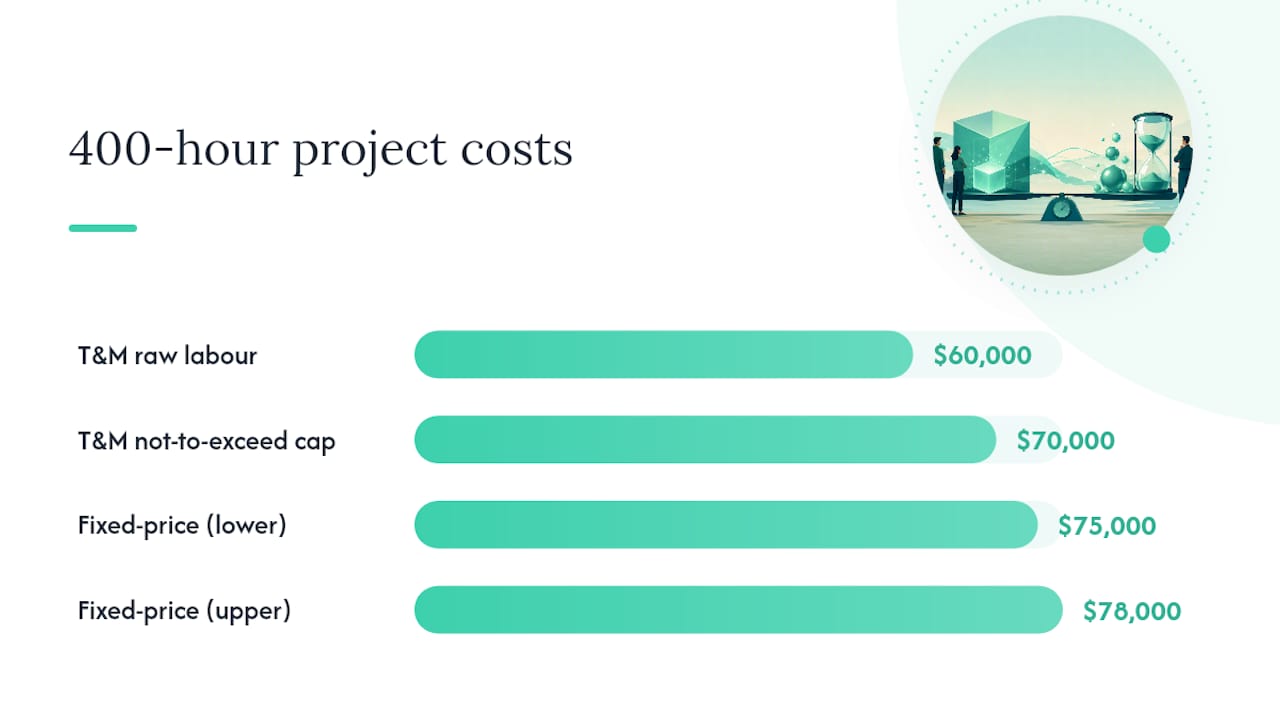
Now compare that to T&M with a not-to-exceed cap set at, say, $70,000. You get the efficiency incentive of hourly billing, the vendor still bills real hours, but you get budget protection too, since they can’t invoice past the ceiling without a formal amendment. This structure captures most of the upside of both models.
A few practical levers make that comparison work in your favor:
- Blended rates: ask whether the quoted rate averages senior and junior staff time; a lower blended rate sometimes hides more junior hours than you’d want on complex work.
- Not-to-exceed clauses: always negotiate one into a T&M contract if you can’t get a fixed price you trust.
- Line-item assumptions: request a written breakdown of what the vendor assumed about scope, tools, and your availability, since that document becomes your leverage if disputes arise later.
Contract clauses around acceptance criteria and change orders often decide project outcomes more than the billing model itself, a point GMWARE’s practitioner analysis makes clearly. The billing model sets who absorbs risk. The contract language decides how painful that risk actually is when it shows up.
How Do You Decide Between Fixed Price and Hourly?
Run through this sequence before you commit to either model:
- Can you describe the deliverable in one sentence? If you can say exactly what the client or your team gets, in one clean sentence, fixed price is workable. If you need three paragraphs and a few caveats, you’re not ready to fix-bid it, per the freelancer test outlined by WhatShouldICharge.
- Do you have a product owner available for weekly decisions? T&M and iterative work demand someone on your side making calls regularly. If nobody has that bandwidth, fixed price with a locked scope reduces the decision load.
- How rigid is your funding? Fixed budgets approved through procurement or a board favor fixed-price contracts, since finance teams generally dislike open-ended numbers.
- How sensitive is your timeline to changes? If a delay costs you real money (a launch date tied to marketing spend, a seasonal window), hourly billing with active governance often surfaces problems earlier than a fixed contract that hides slippage until the deadline.
When you negotiate, push on five specific items: a discovery phase scoped separately from execution, written acceptance criteria for what “done” means, a named team (not “a developer from our bench”), a change-order pricing table agreed in advance, and clear warranty or support terms after launch. GMWARE’s guidance treats these five clauses as more decisive than the pricing model itself, and that matches what shows up in disputes: it’s rarely the hourly rate that causes conflict, it’s the missing clause nobody thought to ask about.
Pro Tip: If you’re a freelancer converting an hourly estimate into a flat project fee, a common starting formula is estimated hours × your hourly rate × 1.2, the 20% multiplier covers the buffer a fixed price requires. Adjust up for unfamiliar clients or ambiguous scope, and down for repeat clients whose working style you already know, per WhatShouldICharge’s conversion guidance.
Why Discovery-Then-Fixed Is Becoming the Default Approach
The pattern practitioners increasingly reach for isn’t fixed price or hourly in isolation, it’s a short T&M discovery phase that gets converted into a fixed-price build. Refact’s guide to fixed price versus time and materials describes this hybrid as the dominant approach precisely because fixed-price contracts frozen at signature tend to fail once real requirements surface.
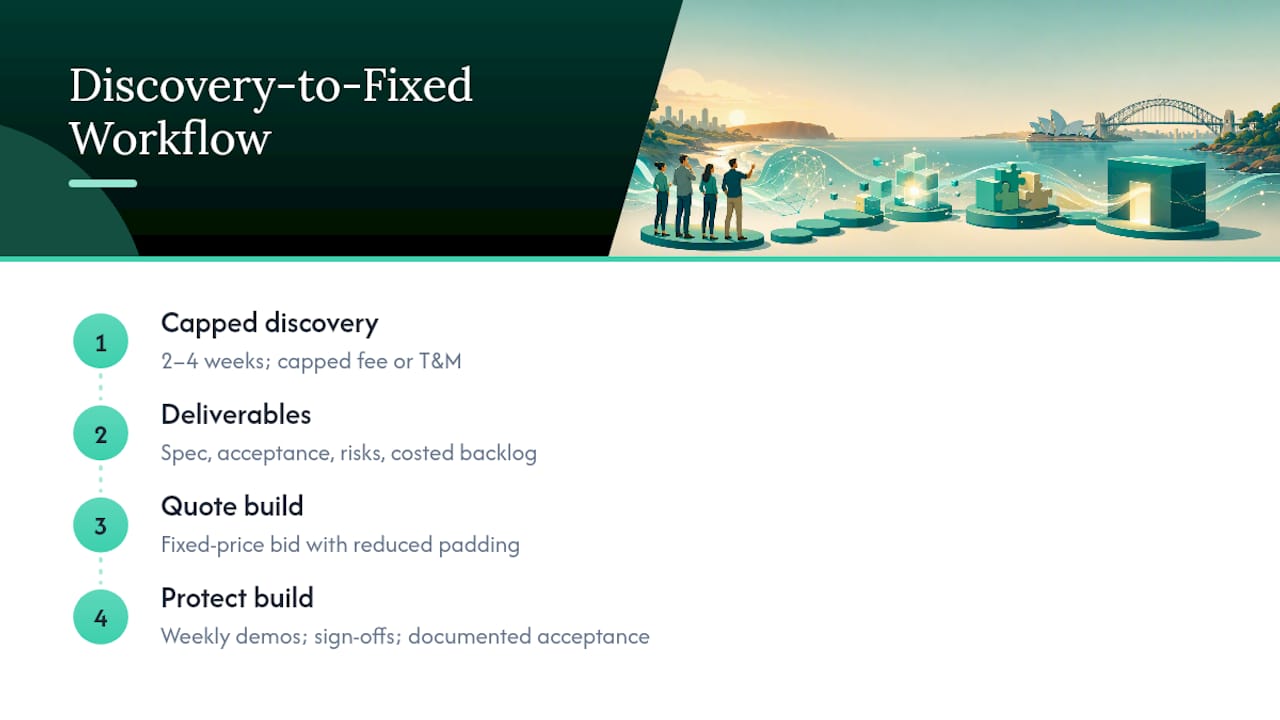
Discovery needs to produce four concrete things before anyone prices the build phase: a written specification, agreed acceptance criteria, a risk register naming the biggest unknowns, and a costed backlog breaking the work into priced chunks. Skip any of these and you’re just delaying the same guesswork to a later, more expensive stage.
Price discovery itself as either a small capped fixed fee or a short T&M engagement with a hard cap, typically two to four weeks depending on complexity. Once discovery wraps, the vendor can quote the build phase with far less padding, because the biggest unknowns are now documented instead of guessed at. Running a capped discovery phase first typically shrinks the certainty premium a vendor needs to charge later, which is the mechanical reason hybrid pricing tends to land cheaper than fixed price alone.
Protect both sides during the build with a few simple artifacts: weekly demos so nobody discovers problems at the finish line, named sign-offs on each milestone, and a documented acceptance process for every deliverable before payment releases.
What Curated Quotes Reveal About Hidden Assumptions
The clearest red flag in any quote isn’t the price, it’s the silence around it. A fixed bid that comes in dramatically lower than competitors usually means the vendor assumed something optimistic: fewer revisions, a simpler integration, or that you’ll provide content and assets on day one. Ask what’s excluded before you ask what’s included.
The same goes for governance. A vendor who resists weekly demos, or won’t commit to a named team, is often signaling that they plan to run the project loosely and hope it comes together. That reluctance shows up more clearly once you’re comparing several quotes side by side, since assumptions that look normal in isolation start looking odd against three other bids for the same brief.
One pattern worth borrowing: a client running a mobile MVP once split the engagement into a two-week capped discovery, roughly $4,000, that mapped the real feature set and flagged an API integration nobody had scoped properly. The fixed build quote that followed came in tighter than the vendor’s original ballpark estimate, and there were no scope disputes during delivery, because the spec had already absorbed the surprises discovery was built to catch.
Comparing multiple quotes for the same brief is genuinely the fastest way to spot which assumptions are reasonable and which are padding dressed up as caution.
— 5Quotes
Get Comparable Bids Before You Commit to Either Model
Reading about buffers and change-order clauses only gets you so far. The fastest way to know whether a quote is fair is to see it next to four others pricing the same brief. A platform exists for exactly that moment: post your project once, and multiple vetted developers respond with their own take on scope, timeline, and price, whether you’re leaning fixed price or hourly.
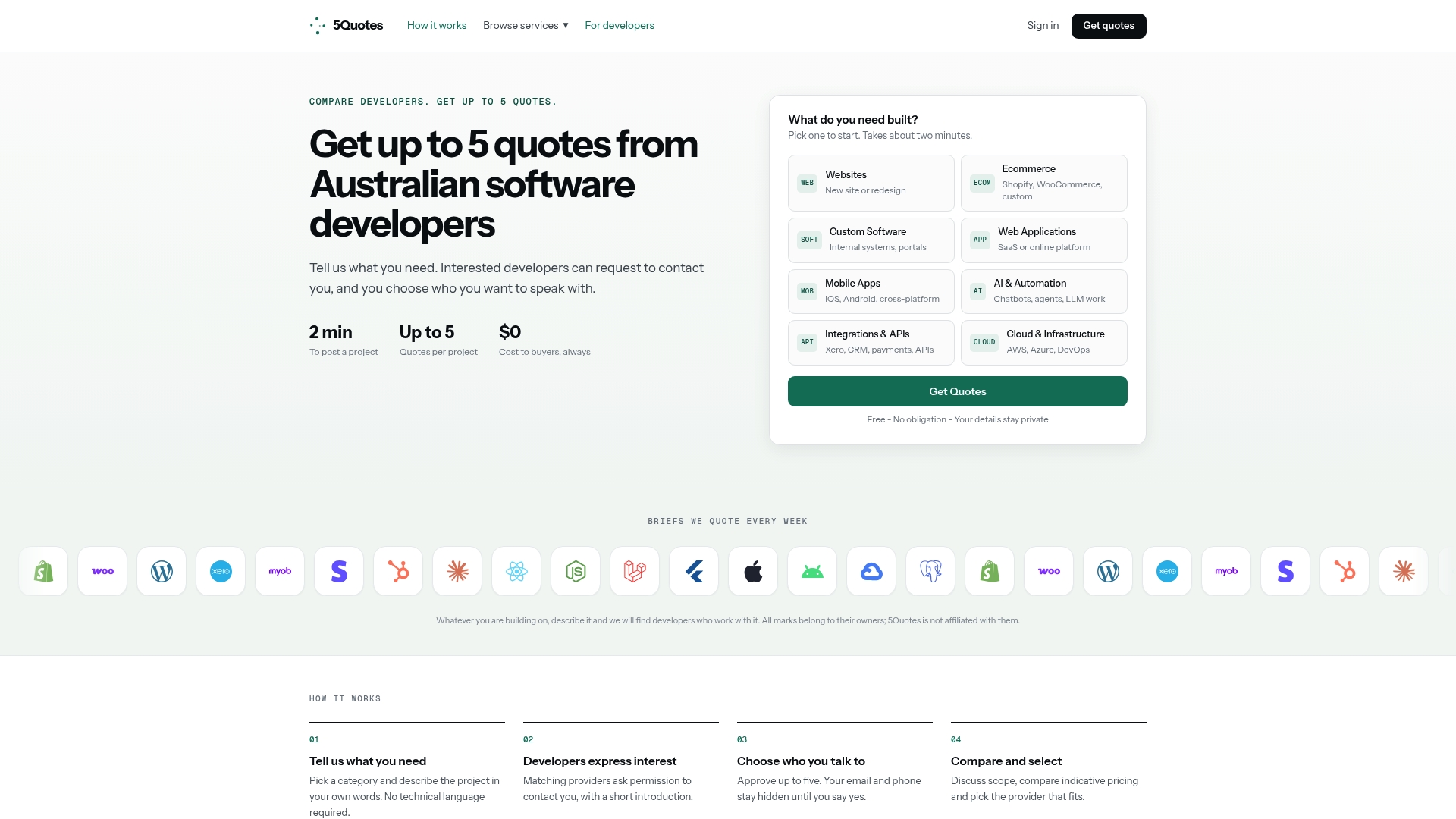
Because developers on the platform are vetted before they can contact you, and your details stay private until you choose to respond, you get quotes without the unsolicited-outreach problem that usually follows posting a project publicly. Comparing five real quotes side by side is also the quickest way to see who’s padding a fixed bid and who’s quietly planning loose hourly oversight, the exact assumptions this article has been walking through. If you’re weighing a fixed-price website build against an hourly custom software engagement, get up to five tailored quotes and compare the actual numbers, not just the theory.
Sources
- Fixed Price vs Time and Materials: Which Contract Protects You? | GMWARE
- Fixed-price vs time materials — NetSuite
- Fixed Price vs Time and Materials: A Practical Guide | Refact
- Hourly Rate vs Project Fee — Which to Charge | WhatShouldICharge
FAQ
What does “fixed price” mean in a development contract?
Fixed price means you and the developer agree on a total cost before work begins, and that number doesn’t change even if the work takes longer than expected. The vendor absorbs the risk of overruns, which is why fixed bids typically include a 15% to 30% buffer to cover that exposure.
Should I charge hourly or a flat rate as a freelancer?
Charge a flat rate when you can describe the deliverable in one clear sentence; charge hourly when the scope is still uncertain or likely to shift. A common conversion is estimated hours times your rate times roughly 1.2, per freelancer pricing guidance.
Which is better, fixed price or time and materials?
Neither wins outright, they allocate risk differently. Fixed price suits small, well-defined work where budget certainty matters most, while T&M suits iterative or evolving projects, and most non-trivial engagements do best with a capped discovery phase first followed by a fixed-price build.
What’s better, a day rate or an hourly rate?
Day rates simplify invoicing for full-day engagements and suit senior contractors billing in blocks, while hourly rates offer finer-grained tracking for part-time or fragmented work. Neither is inherently better; the right choice depends on how your engagement is structured, not the billing unit itself.
How much does it cost to get developer quotes through 5quotes?
Posting a project and receiving quotes through 5quotes is free for buyers; developers pay for the introduction, not you. Current details on how the platform works are available on 5quotes’ how-it-works page.
Recommended
Read next
Getting this built?
Tell us what you need and compare up to 5 quotes from developers who do this work.
Get quotes