HomeServicesShopify Development

Shopify Development in New Zealand
Shopify runs the shop so you do not have to. You pay for that in fees and in the things it will not let you change — which is a good trade for most retailers and a bad one for a few.
$15k+
Typical project value
2 min
To post a project
What do you need built?
Start here and add detail as you go.
Free - No obligation - Your details stay private
What people usually mean by shopify development
Shopify briefs split cleanly: a store on an existing theme, a custom theme built to a design, or development work on a store that already trades. The first is weeks, the last is where most of the interesting money is, and confusing them is how quotes end up wildly apart.
A store on a good theme
A well-chosen theme configured properly, your products loaded, payments and shipping set up, and enough customisation that it does not look like the demo.
A custom theme
Built to a design, usually because the brand matters or the buying experience is unusual. More design cost than development cost.
Custom functionality
A private app, a bespoke checkout experience on Plus, subscriptions, B2B pricing, or an integration with the systems that run your warehouse and accounts.
What it costs
Indicative ranges from projects posted here. Use them to sense-check a quote, not to budget precisely.
Themed store
A premium theme, configured well, with your catalogue and standard payments and shipping.
$8k – $20k
Custom theme or migration
Designed and built to your brand, or moved from another platform with redirects handled properly.
$20k – $50k
Custom development
Private apps, B2B pricing, subscriptions, ERP and warehouse integration, Shopify Plus work.
$50k+
Questions worth asking a provider
·Which apps will this store depend on, and what do they cost per month in total?
·Can this be done in the theme, or does it need a private app? What is the difference in cost?
·How will you handle redirects from our current URLs so we keep our rankings?
·Who updates the theme when Shopify releases changes?
·Can I see a store you built that is still trading, and speak to the owner?
Common questions
How much does a Shopify store cost in New Zealand?
A well-configured store on a premium theme is $8,000 to $20,000. A custom theme built to a design, or a migration from another platform, is $20,000 to $50,000. Custom functionality — private apps, B2B pricing, subscriptions, ERP integration — starts around $50,000. Shopify's own subscription is separate and starts at about $50 a month.
Shopify or WooCommerce?
Shopify if you want to be trading quickly, do not want to think about hosting or security, and can live inside its rules. WooCommerce if your pricing or process is unusual enough that you need to change things Shopify will not let you touch, and you have someone to maintain it. Shopify costs less to build and more to run; WooCommerce is the reverse.
What do the apps really cost?
This is the number most quotes leave out. A store leaning on eight apps at $20 to $50 a month each is $2,000 to $5,000 a year before you have sold anything, forever. Ask for the full monthly total alongside the build price, and ask which apps could be replaced by theme work.
Do I need Shopify Plus?
Only if you need checkout customisation, B2B features, or you are large enough that the transaction fee saving covers the cost. Most New Zealand retailers do not, and a developer suggesting it early should be able to explain precisely which feature you need it for.
How long does it take?
Three to six weeks for a themed store if your product data and photography are ready. Eight to twelve weeks for a custom theme. The most common cause of delay is not development — it is waiting on product information and images.
Shopify Development projects open right now
Titles and categories are public. Full briefs, budgets, regions and buyer detail are visible to approved providers only.
Updated daily
No open projects in this category right now. New briefs are posted every week.
ShopifyShopify is a trademark of Shopify Inc. 5Quotes is not affiliated with them. Logo via Simple Icons (CC0).Visit site →What you are actually paying for
Shopify handles hosting, security, PCI compliance, uptime and the checkout. None of that appears on your invoice from a developer, and all of it would if you built the same shop yourself. That is the deal: you rent a very good storefront and never think about servers again.
The price of the deal is the parts you cannot change. The checkout is Shopify's until you are on Plus. Some pricing models simply are not supported. When you hit one of those walls, you do not negotiate with it — you work around it or you leave.
For most retailers that is a straightforwardly good trade.

Three different projects with the same name
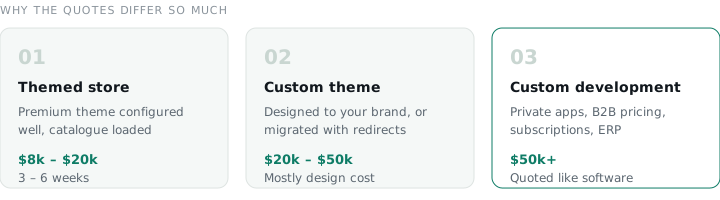
Quotes for "a Shopify store" come back wildly apart because people are pricing different things.
- A themed store takes a good premium theme, configures it properly, loads your catalogue and gets payments and shipping right. Three to six weeks. It looks professional and it is nobody's bespoke creation, which is fine — the theme is not what sells your products.
- A custom theme is built to a design, usually because the brand carries weight or the way people choose products is unusual. Most of that budget is design, not development.
- Custom functionality is where the real engineering lives: a private app, B2B pricing, subscriptions, an integration with your warehouse or accounting system. This is quoted like software, because it is software.
Be explicit about which one you want, or you will be comparing three different proposals against each other and wondering why one is a quarter of the price.
The app bill nobody mentions
Shopify's ecosystem is genuinely excellent, and it is also how a $12,000 store acquires a $400 monthly habit.
Reviews, subscriptions, bundles, wishlists, upsells, advanced search, a better page builder, freight rules — each is $20 to $50 a month and each is very easy to justify on its own. Eight of them is $3,000 to $5,000 a year, forever, and it rarely appears in a quote.
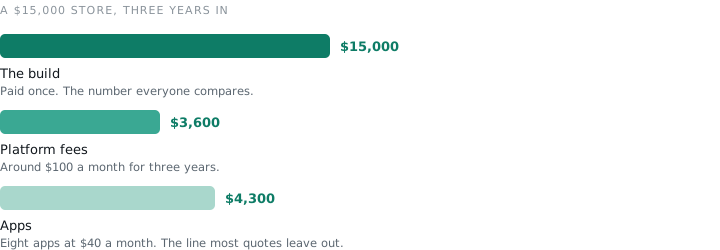
Ask every developer for the monthly app total alongside the build price, and ask which of those apps could be replaced by theme work. Sometimes paying $1,500 once is better than $40 a month for a decade. Sometimes it is not, and a good developer will tell you which is which rather than defaulting to whichever earns them more.
Migrating from another platform
The products, customers and order history move without much drama. The part that decides whether the migration succeeded is redirects.
Your current store has URLs Google has indexed and other sites link to. Change them without redirecting and that traffic disappears, along with rankings you have already paid for — usually noticed about six weeks later, when it is hard to diagnose and slow to recover.
Ask specifically how old URLs will be mapped to new ones and how that gets tested. A developer who answers precisely has done a migration before. One who waves it away has not, or did not enjoy it.
Do you need Plus?
Shopify Plus costs several times the standard plan and buys checkout customisation, proper B2B features, and better rates at volume. It is right for some businesses and oversold to many more.
The test is whether you can name the specific thing you need it for. "We want to customise the checkout" is a reason. "We are growing" is not. If a developer recommends Plus, ask which feature you are buying and what it would cost to live without it for another year.
What to compare
- Total monthly cost. Shopify plan plus every app, stated in the quote.
- Theme or app? For each custom requirement, which approach and why. This is where technical judgement shows.
- Who does the product data? Loading a thousand products with variants and images is real work, and quotes differ on whether it is included.
- After launch. Themes need occasional updating and apps break. Ask what support costs monthly.
- A store still trading. Ask to see one built two years ago, and to speak to the owner.
Describe what you sell
You do not need to know whether you need a theme, an app or Plus. Describe what you sell, how customers choose it, and anything unusual about your pricing or delivery. Developers who build Shopify stores every week will tell you which of the three projects you actually have — and if they disagree with each other, that disagreement is the most useful thing you will learn.
Related services
Not quite what you are after? These are the briefs most often confused with shopify development.
Get up to 5 quotes for your shopify development project
You choose who may contact you. Free to use, no obligation.