HomeServicesWooCommerce Development

WooCommerce Development in New Zealand
WooCommerce turns WordPress into a shop you own outright. No monthly platform fee, no transaction cut, and no limit on what you can change — which is exactly why quotes for it vary so much.
$12k+
Typical project value
2 min
To post a project
What do you need built?
Start here and add detail as you go.
Free - No obligation - Your details stay private
What people usually mean by woocommerce development
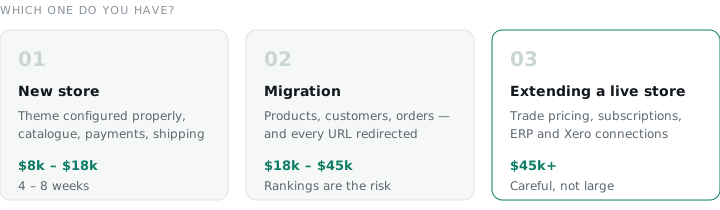
Most WooCommerce briefs are one of three jobs: a new store on a theme, a migration off Shopify or a legacy cart, or surgery on a store that already trades and cannot go down. They cost very different amounts, and the first thing a good developer will do is work out which one you actually have.
A new store on solid foundations
A theme, your catalogue, payments and shipping configured properly, and enough custom work that it does not look like everyone else's. Usually 4 to 8 weeks.
Migrating an existing store
Products, customers, orders and — the part people forget — every URL redirected so you keep the search rankings you already paid for.
Extending a store that already trades
Custom checkout logic, subscriptions, trade pricing, an ERP or Xero connection. The work is careful rather than large, because the store cannot stop taking money.
What it costs
Indicative ranges from projects posted here. Use them to sense-check a quote, not to budget precisely.
Straightforward store
A good theme configured well, a few hundred products, standard payments and shipping.
$8k – $18k
Custom build or migration
A designed theme, a migration with redirects, or trade pricing and customer groups.
$18k – $45k
Complex commerce
Subscriptions, multi-warehouse stock, ERP integration, or a store doing serious volume.
$45k+
Questions worth asking a provider
·Which plugins will this depend on, and what happens if one stops being maintained?
·Who is responsible for updates after launch, and what does that cost each month?
·How will you handle the migration of existing URLs so we keep our search rankings?
·What is the hosting plan? WooCommerce is heavier than a brochure site.
·Can I see a store you built that is still trading two years later?
Common questions
How much does WooCommerce development cost in New Zealand?
Most New Zealand WooCommerce projects land between $8,000 and $45,000. A store on a well-configured theme with a few hundred products sits at the lower end. A migration, a designed theme, or trade pricing and customer groups pushes it higher. Subscriptions, multi-warehouse stock or an ERP connection can exceed $45,000.
Is WooCommerce cheaper than Shopify?
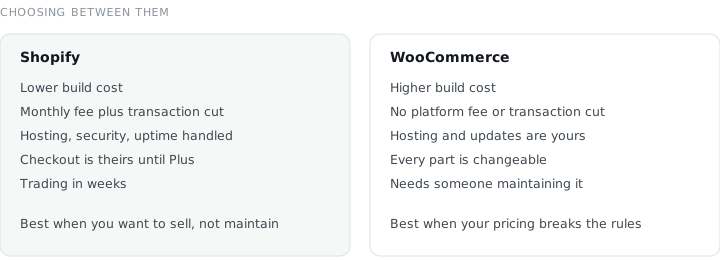
The software is free, and there is no transaction fee or monthly platform charge, but you pay for hosting, maintenance and any premium plugins. WooCommerce usually costs more to build and less to run. It wins when you need something Shopify will not let you change; Shopify wins when you want to launch quickly and never think about servers.
Can I migrate from Shopify to WooCommerce?
Yes, and it is a common brief. Products, customers and order history all move. The part that matters most is redirecting your old URLs to the new ones — skip it and you lose the search rankings you have already paid for. Ask every developer how they plan to handle redirects.
How long does a WooCommerce store take to build?
Four to eight weeks for a straightforward store, assuming your product data and images are ready. Migrations and custom checkout work run longer. The most common cause of delay is not the build — it is waiting on content and product information from the client.
Who maintains the store after it launches?
Someone has to. WooCommerce, WordPress and every plugin release security updates, and a store that stops being updated eventually breaks or gets compromised. Agree this before you sign: either a monthly retainer with your developer, or a clear handover to whoever will do it internally.
WooCommerce Development projects open right now
Titles and categories are public. Full briefs, budgets, regions and buyer detail are visible to approved providers only.
Updated daily
No open projects in this category right now. New briefs are posted every week.
WooCommerceWooCommerce is a trademark of Automattic Inc. 5Quotes is not affiliated with them. Logo via Simple Icons (CC0).Visit site →You own the shop, not a licence to use one
Every hosted platform rents you a storefront. The rent is reasonable until it isn't: a percentage of every sale, a monthly fee that scales with your catalogue, and a hard edge where the platform says no, you can't do that. WooCommerce has no edge. It is WordPress with a shop attached, it runs on your hosting, and the code is yours. Nobody can put the price up, change the checkout, or decide your business model is no longer supported.
That freedom is the whole argument, and it cuts both ways. Nobody is on call when a plugin update breaks your checkout at 9pm on Black Friday. Ownership means responsibility, and the developers worth hiring will tell you that before you sign.
What a WooCommerce store can look like
None of these look like a template, and none of them look like each other. That is the point of owning the front end rather than renting it.

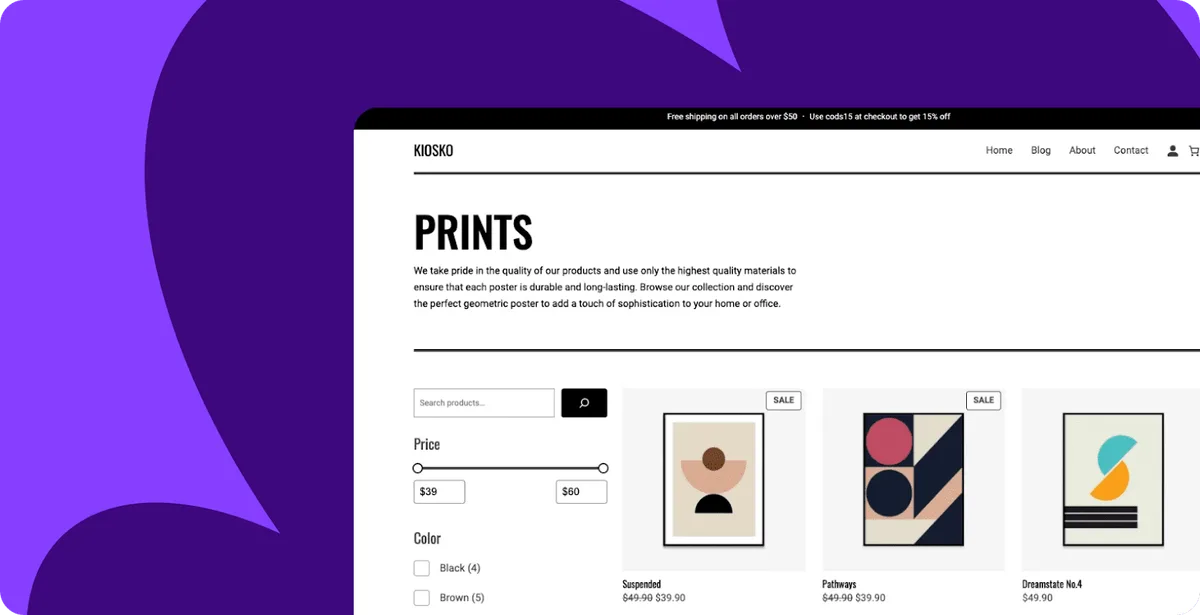

Store images courtesy of WooCommerce. WooCommerce is a trademark of Automattic Inc.; 5Quotes is not affiliated with them.
What WooCommerce is genuinely good at
- Selling in ways platforms don't anticipate. Trade pricing by customer group, quote-then-order, hire periods, deposits, made-to-order configurations, bundles priced by weight. If your pricing needs a paragraph to explain, WooCommerce can do it and most hosted platforms cannot.
- Content and commerce in one place. WooCommerce inherits WordPress, which still runs a serious share of the web because it is very good at publishing. If your customers buy after reading — guides, specifications, comparisons — having the content and the cart in one system is a real advantage.
- Not paying a percentage forever. A store turning over $2m a year on a 2% platform-plus-transaction cost is spending $40,000 annually on the privilege. That number funds a lot of development.
When you should not choose it
If you sell a few dozen simple products and want to be trading next month with nobody to maintain it, use Shopify. Genuinely. A WooCommerce store with no one looking after it degrades: plugins go unmaintained, PHP versions move on, and eventually something breaks in a way that costs more to fix than the platform fees you avoided.
The honest test is whether you will have a developer — in-house, on retainer, or on call. If the answer is no, rent the storefront.
Where the money actually goes
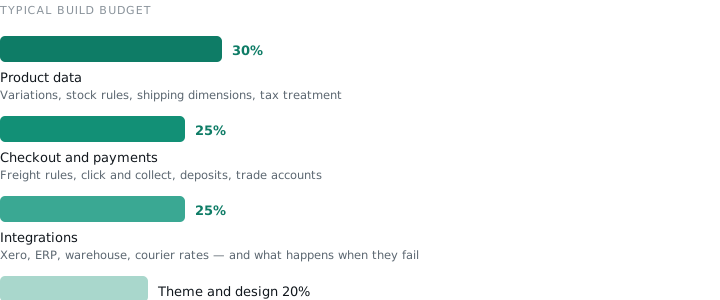
Buyers are often surprised that the shop itself is the cheap part. Installing WooCommerce takes minutes. The cost lives in:
- Your product data. Variations, options, stock rules, shipping dimensions, tax treatment. A thousand products with three variations each is thirty thousand price and stock decisions, and someone has to get them right.
- Checkout and payment. The default checkout works. Yours probably needs to do something specific — freight quoted by weight and rural delivery, click-and-collect, purchase orders for trade accounts, deposits on made-to-order items.
- Whatever it connects to. Xero, an ERP, a warehouse system, a courier's rate API. Most of the cost of an integration is not the happy path; it is what happens when the other end is down, slow, or returns something nobody expected.
- Performance. WooCommerce is heavier than a brochure site. A store with real traffic and a large catalogue needs proper hosting, caching that understands carts and logged-in customers, and someone who has tuned one before.
Migrating an existing store
Moving to WooCommerce is a well-trodden path, and the mechanical part — products, customers, order history — is close to routine. The part that decides whether the migration was a success is redirects.
Your existing store has URLs that Google has indexed and other sites link to. If those addresses change without a redirect, that traffic is gone, and you will be rebuilding rankings you already paid for. Ask every developer quoting on a migration how they will map old URLs to new ones. A good answer is specific and mentions testing. A vague answer is a warning.
How to read five WooCommerce quotes
You will get a wide spread, and the cheapest is rarely the cheapest. Read for:
- Plugin strategy. A store assembled from fifteen premium plugins is fast to build and painful to maintain. Some plugins are excellent; some are abandoned within two years. Ask what each one does and what happens if it stops being updated.
- What happens after launch. A quote that ends at go-live is only half a proposal. Ask what maintenance costs monthly, and what it covers.
- Hosting. "You arrange hosting" in a quote usually means the store will be slow and it will be nobody's fault.
- Who does the work. Ask who will actually write the code and whether you can talk to them.
Ready to compare?
Describe what you sell and how you want to sell it — in plain language, no technical detail needed. Developers who work on WooCommerce every week will read it and ask to contact you, and you choose which of them gets your details. It is free, and there is no obligation to hire anyone.
Related services
Not quite what you are after? These are the briefs most often confused with woocommerce development.
Get up to 5 quotes for your woocommerce development project
You choose who may contact you. Free to use, no obligation.