16 September 2026
4–6 Month MVP for $35k–$55k: Flutter vs React Native for New Zealand
Compare Flutter and React Native for New Zealand projects: hiring speed, time-to-MVP, and 4–6 month $35k–$55k cost benchmarks plus a short decision checklist.
4–6 Month MVP for $35k–$55k: Flutter vs React Native for New Zealand
Pick Flutter when your app leans on custom design, heavy animation, or plans to reach web and desktop from one codebase. Pick React Native when your team already knows React, you need to share code with a web app, or you need to hire fast. Both frameworks now perform well for the vast majority of apps in 2026. The real decision hinges on your hiring pool, your UI ambitions, and your roadmap, not raw speed. Check the decision checklist below to confirm which one fits your specific product.
TL;DR:
- React Native benefits from a larger talent pool and faster hiring times, making it preferable for teams needing quick staffing or already familiar with React.
- Flutter is more suitable for design-heavy, multi-platform apps requiring pixel-perfect visuals and consistent performance across devices, especially in animation-rich interfaces.
- Cost estimates for a typical app are similar, around $35,000 to $55,000, but Flutter projects tend to have lower long-term maintenance costs due to its unified rendering engine.
- Both frameworks now offer competitive performance for most workloads, with Flutter holding an edge in high-performance animations and React Native closing the gap through architectural improvements.
- Confirm your project’s specific needs, such as design complexity, existing team skills, and platform reach, and get developer quotes to choose the more suitable framework for your MVP.
Table of Contents
- Flutter vs React Native at a Glance
- How Do the Architectures Affect Real Performance?
- Which Framework Is Easier to Learn and Staff?
- How Mature Are the Package Ecosystems?
- What Does an MVP Actually Cost in 2026?
- Which Framework Fits Your Project?
- Getting Vetted Flutter or React Native Developers Through 5quotes
- The Real Decision Isn’t Technical
- Ready to Compare Real Quotes From Developers Who Build This Daily?
- Primary Sources and Documentation
- Sources
- FAQ
Flutter vs React Native at a Glance
Neither framework wins across the board, and that’s the point. You’re not choosing a winner, you’re matching tools to your project’s actual constraints.
- Language: Flutter uses Dart, a language most teams learn from scratch. React Native uses JavaScript or TypeScript, which overlaps directly with web development skills.
- Rendering model: Flutter draws its own pixels through its own engine, giving it consistent visuals across every device. React Native increasingly renders through native platform components via its modern architecture.
- Platform reach: Flutter extends further into desktop and embedded targets out of the box. React Native’s strength is sharing logic and, in some cases, UI code with an existing React web app.
- Hiring speed: React Native draws from the much larger JavaScript talent pool, which usually means faster staffing.
- Typical use case: Flutter suits design-led consumer apps and multi-platform product lines. React Native suits teams extending an existing React codebase or racing to hire a team fast.
If your goal is a fast, functional MVP with a small existing React team, lean React Native. If your goal is a polished, brand-heavy app running identically on multiple screens, lean Flutter.
How Do the Architectures Affect Real Performance?
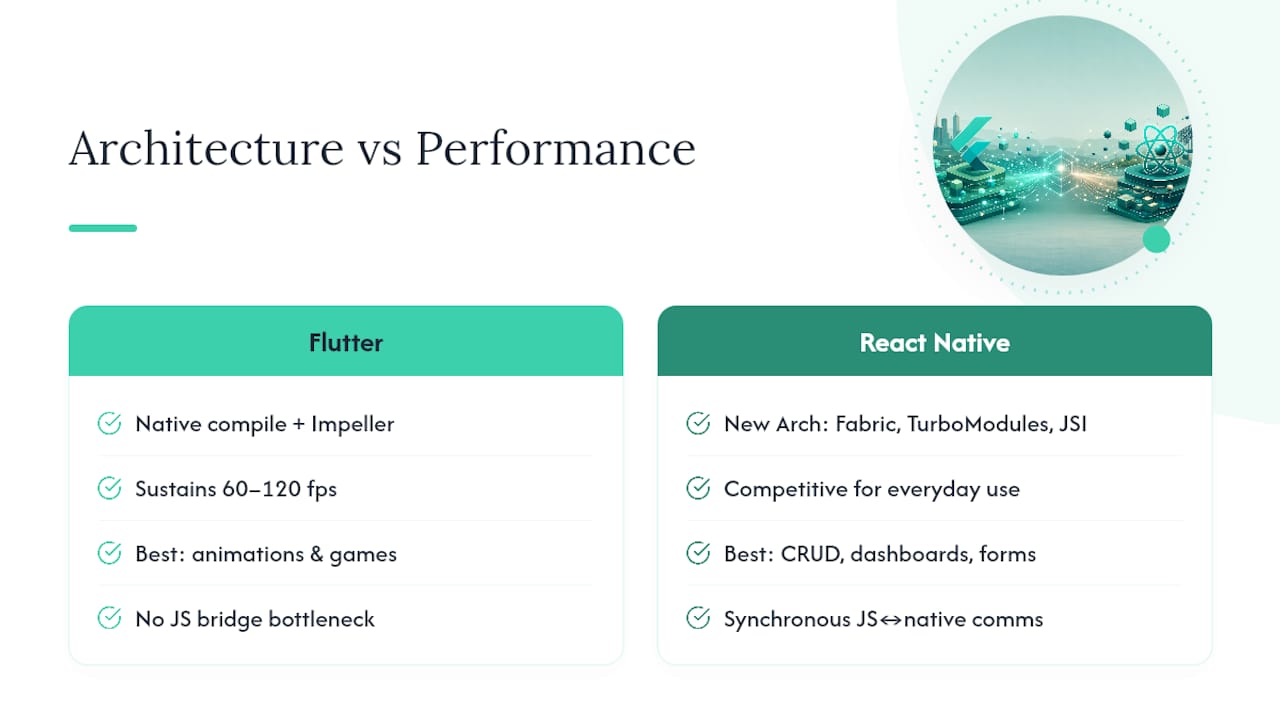
Flutter compiles to native code and renders every pixel itself through its Impeller engine, which sidesteps the JavaScript bridge bottlenecks that used to plague cross-platform frameworks. That architecture gives Flutter an edge in animation-heavy interfaces. Measured comparisons show Flutter holding close to 60 or 120 frames per second under sustained animation load, where older React Native builds would drop frames under similar stress.
React Native has closed most of that gap. Its New Architecture, built around Fabric, TurboModules, and JSI, replaced the old asynchronous bridge with direct, synchronous communication between JavaScript and native code. That change has materially narrowed the historical performance difference, and cold-start times and everyday animations are now competitive for most apps.
For a typical CRUD app, a SaaS dashboard, or a form-heavy business tool, none of this matters much. Both frameworks handle that workload comfortably. The differences show up in real-time visuals, complex custom transitions, or apps that need to sustain 120 fps under load, like games or camera-heavy tools. And when you hit a wall either framework can’t solve natively, both offer an escape hatch: Flutter’s platform channels let you drop into native Swift or Kotlin code for the rare feature that needs it, and React Native offers a parallel native-module system.
Which Framework Is Easier to Learn and Staff?
Dart is a clean, strongly typed language, and most engineers pick up its basics within a couple of weeks. The friction usually shows up later, in Flutter’s widget-tree mental model, which feels unfamiliar even to experienced mobile developers. JavaScript and TypeScript onboarding is typically faster for teams that already write React for the web, since the component patterns, state management, and even some UI code can carry over directly.
- Hot reload and tooling: both frameworks support fast hot reload, but Flutter’s DevTools give you a slightly more integrated view of widget trees, performance timelines, and layout issues in one place.
- Native bridge debugging: React Native’s native-module debugging can get complicated once you’re troubleshooting across JavaScript, TurboModules, and platform code simultaneously.
- Hiring pool: React and JavaScript talent is broader and easier to find on short notice, and several 2026 hiring analyses point to faster staffing for React Native teams as a direct result.
- Time-to-hire risk: if your MVP timeline is aggressive and you don’t already have Flutter developers on staff, hiring lag can eat weeks you don’t have.
Pro Tip: Pair a new Flutter hire with your most senior React developer for the first sprint. Shared contracts (API schemas, design tokens, state shapes) preserve velocity far better than solo onboarding, regardless of which framework you pick.
How Mature Are the Package Ecosystems?
React Native has the longer track record, and it shows in raw package count and the depth of community-maintained wrappers around vendor SDKs. Flutter’s ecosystem has matured quickly but still has thinner coverage in a handful of specialty categories, like advanced native camera controls, some payment SDKs, and a few analytics platforms that ship native-only libraries.
Web and desktop readiness favor Flutter, which was built with multi-platform rendering as a core goal rather than an afterthought. Some teams reach for Electron for a similar cross-platform desktop story, but Flutter’s shared codebase can cover ground Electron would separately require.
Before you commit to a plugin, check three things: when it was last updated, whether it wraps native bindings directly or leans on a third-party fork, and whether it explicitly lists support for every platform your roadmap needs. When a vendor only ships a native SDK, budget a few extra developer days to write a thin platform-channel wrapper rather than assuming a community package will appear in time.
What Does an MVP Actually Cost in 2026?
For a typical 6 to 10 screen app with authentication, payments, and API integration, expect $35,000 to $50,000 on React Native and $40,000 to $55,000 on Flutter, spread across roughly four to six months. Both ranges represent a 30 to 60% savings compared to building separate native iOS and Android apps.
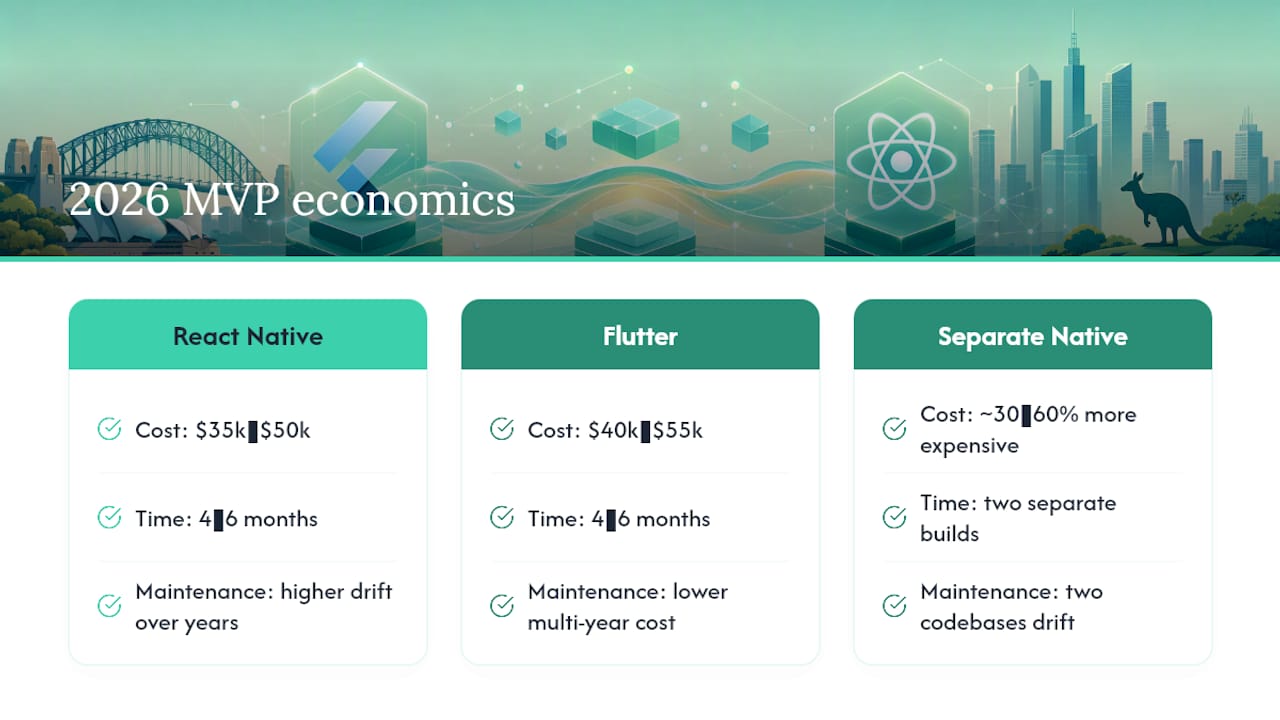
That upfront gap doesn’t tell the whole story. Flutter projects often cost slightly more to start but less to maintain over multiple years, because a single rendering engine avoids the platform-specific visual bugs that creep in when two native codebases drift apart over time. Teams running dual native codebases frequently hit this maintenance drift, where an iOS fix ships weeks before its Android equivalent, and the two versions slowly diverge.
Costs climb fastest when a team bolts native modules onto a cross-platform base for one or two features and then keeps adding more over time, effectively building a third codebase nobody planned for. Keep total cost of ownership down by limiting native escape hatches to genuinely necessary cases, documenting every one you use, and revisiting your plugin list at each major OS update rather than waiting for something to break in production.
Which Framework Fits Your Project?
Answer these five questions honestly before you brief a developer or an agency:
- Does your app depend on custom, pixel-precise design or heavy animation? If yes, favor Flutter.
- Do you need to share code or logic with an existing React web app? If yes, favor React Native.
- Do you already have React developers on staff or on retainer? If yes, React Native shortens your ramp time.
- Is time-to-hire your biggest constraint? React Native’s larger talent pool usually gets you staffed faster.
- Does your app need deep hardware access, like custom Bluetooth protocols or specialized camera processing? Either framework can handle it through native modules, but budget extra time either way.
When you interview candidates or agencies, ask them to walk you through a past project where they hit a native-module wall and how they solved it. Their answer tells you more about real-world competence than any resume line about years of experience.
Getting Vetted Flutter or React Native Developers Through 5quotes
Once you’ve settled on a framework, the next bottleneck is usually finding developers who’ve actually shipped production apps in it, not just listed it as a skill. 5quotes lets you post your project once and receive up to five tailored quotes from vetted New Zealand developers who specialize in Flutter or React Native.
Every developer on the platform goes through a vetting process before they can contact you, and your contact details stay private until you choose who to respond to. That means no cold outreach flooding your inbox the moment you post. Most projects receive their first round of quotes within a few business days, giving you a real comparison of cost, timeline, and approach before committing to a hiring agency or running your own search from scratch.
The Real Decision Isn’t Technical
Most teams spend weeks debating frame rates and rendering engines when the deciding factor is almost always their own hiring reality and product roadmap. If you’ve already got React developers or need to move fast, React Native removes friction. If your product lives or dies on visual polish across platforms, Flutter earns its slightly higher starting cost. Either way, get quotes before you assume which path is cheaper for your specific build.
— 5Quotes
Ready to Compare Real Quotes From Developers Who Build This Daily?
Reading about frame rates and hiring pools only gets you so far. What actually moves your project forward is talking to developers who’ve shipped apps in your exact framework and can quote your specific screens, integrations, and timeline. 5quotes is built for exactly that gap between research and hiring.
Post your project once through the mobile app development page, and you’ll receive up to five tailored quotes from vetted New Zealand developers, without your details going out to anyone you haven’t approved. Before you post, have a rough screen count, your must-have integrations (payments, maps, push notifications), and your target launch window ready. That level of detail is what separates a vague quote from one you can actually act on. If your project also touches a custom backend or API work, the mobile backend developers page covers that side too. Get your quotes started and compare real numbers before you commit to either framework.
Primary Sources and Documentation
- Flutter vs React Native 2026: Which to Pick for Your MVP, for cost benchmarks and Impeller performance data
- Flutter Platform Channels, Flutter’s own documentation on native interop
- I built the same app with Flutter, React Native, and Ionic, a hands-on build comparison worth reading in full
Sources
FAQ
Is Flutter Still Relevant in 2026?
Yes. Flutter remains a leading choice for design-heavy, multi-platform apps, and its Impeller rendering engine keeps it competitive on animation performance even as React Native closes the gap elsewhere.
Is Netflix Using React Native?
Netflix has used React Native for parts of its internal tooling and select product surfaces, though large consumer-facing apps often mix native and cross-platform code depending on the feature. The choice usually reflects team structure and existing codebase investments rather than a blanket framework preference.
Can I Learn Flutter in Three Months?
You can reach a working proficiency in Dart and Flutter’s widget model in about three months with consistent practice, especially if you already know an object-oriented language. Mastering performance tuning, platform channels, and complex state management typically takes longer.
Is Flutter Faster Than Native Apps?
Flutter compiles to native ARM code and can match native performance for most everyday app tasks, but it’s not universally faster than fully native development for every workload. For highly specialized graphics or deep OS integration, native code still tends to have the edge, which is why both Flutter and React Native offer native escape hatches for those cases.
Recommended
Read next
Getting this built?
Tell us what you need and compare up to 5 quotes from developers who do this work.
Get quotes