11 September 2026
Avoid Cost Overruns: 3 Custom Software Cost Bands for New Zealand
New Zealand budgeting playbook using 2026 benchmarks: three cost bands ($15,000–$1.5M), scoped discovery, TCO estimates, and multi-quote vetting to cut...
Avoid Cost Overruns: 3 Custom Software Cost Bands for New Zealand
Most custom software projects fall into three bands: $15,000 to $80,000 for a small tool or MVP, $50,000 to $250,000 for a mid-size business application, and $200,000 to $1.5 million or more for an enterprise platform. Before you trust any quote against those numbers, invest in a scoped discovery phase. It’s the single move that keeps your final bill close to your first estimate.
TL;DR:
- Most small tools and MVPs cost between $15,000 and $80,000, with timelines of 1 to 3 months primarily for a core functionality.
- Mid-size applications typically range from $50,000 to $250,000 and involve several integrations, with delivery times extending to 3 to 6 months.
- Enterprise projects can exceed $1 million, depending on complexity, compliance, and module count, often taking over a year to complete.
- Feature complexity, integrations, and data migration are the biggest cost drivers, and detailed itemization of these elements is essential for accurate quotes.
- Budget breakdown should follow industry benchmarks, allocating around 10% for discovery, 40-60% for engineering, and 10-15% for QA, with additional costs for maintenance and hosting.
Table of Contents
- What Does Custom Software Cost by Project Type?
- What Drives Custom Software Pricing Up or Down?
- How Do Hourly Rates Translate Into Total Cost?
- How Should Your Budget Break Down by Phase?
- What Hidden Costs Should You Budget For?
- How Do You Get Accurate, Comparable Quotes?
- Why Multiple Vetted Quotes Beat a Single Estimate
- Get Scoped Quotes Before You Commit a Budget
- Primary Sources for These Ranges
- Sources
- FAQ
What Does Custom Software Cost by Project Type?
The range you land in depends almost entirely on what “custom software” means for your business. A quoted price without a matching scope is just a guess dressed up as a number.
Small tools and MVPs: $15,000 to $80,000. This covers a minimum viable product built to test a concept, an internal tool that automates one workflow, or a simple customer-facing app with a handful of screens. Timelines run 1 to 3 months. You’re paying for a working core, not polish, and you should expect to iterate after launch rather than ship something feature-complete.
Mid-size business applications: a broad range typical for applications with several integrations and complex features. Think inventory systems, client portals, or booking platforms with several integrations, role-based access, and reporting dashboards. Delivery usually takes 3 to 6 months. Madgeek’s 2026 cost data puts most production projects in a similar $50,000 to $500,000 window, with medians often landing between $75,000 and $150,000.
Enterprise platforms: a wide range reflecting projects with multiple modules, compliance, and extended timelines. These involve multiple interconnected modules, compliance requirements, legacy data migration, and teams working across several months to over a year. The wide top end reflects genuine variance: a platform with strict regulatory audit trails costs dramatically more than one without, even at similar user counts.
A few things separate the floor of a range from its ceiling:
- Floor pricing usually means a smaller offshore or nearshore team, minimal design work, and a narrow feature set.
- Median pricing reflects a properly staffed team, a design phase, and standard integrations.
- Premium vendor signals (fixed-price guarantees, senior-only staffing, in-house QA) push you toward the top of a band, and Clutch’s 2026 pricing data puts the average verified custom software project at roughly $132,480 with a typical timeline near 13 months.
What Drives Custom Software Pricing Up or Down?
Feature count and complexity is the single biggest lever in any quote. Every screen, workflow, and business rule adds engineering hours, and hours are what you’re actually buying, not features.
Integrations come next. Connecting to a payment gateway, CRM, or accounting platform sounds simple until you hit an undocumented API. Madgeek’s guide estimates each integration adds a predictable incremental cost depending on API quality and middleware needs (https://madgeek.ai/resources/custom-software-development-cost-2026), depending on API quality and whether middleware is needed to bridge systems that were never designed to talk to each other.
Data migration is the quiet budget killer.
Other factors that reliably move the number:
- Compliance and security requirements (health data, financial records, government standards) add fixed architecture costs regardless of feature count.
- UX and design polish matters more for customer-facing apps than internal tools, and it’s rarely optional once real users are involved.
- Non-functional requirements like performance under load, uptime guarantees, or multi-region scaling add engineering time that never shows up on a feature list.
Pro Tip: Ask every vendor to itemize integrations and data migration separately in their quote. If a proposal bundles everything into one number, you have no way to tell whether $150,000 was calculated the same way twice.
How Do Hourly Rates Translate Into Total Cost?
Hourly rates vary sharply by seniority and region. Junior developers typically bill $25 to $60 per hour, mid-level developers $60 to $110, and senior specialists $110 to $200 or more, with Clutch’s data showing many reviewed firms clustering around $25 to $49 per hour for standard project work, though rates swing widely by market.
A blended team rate, the average across juniors, mid-levels, and seniors on a project, often lands between $65 and $120 per hour. That number matters more than any single developer’s rate, because total cost is simply hours × blended rate. A 1,200-hour mid-size build at a $90 blended rate runs $108,000 before contingency.
Here’s the trap: a cheap hourly rate does not guarantee a cheap project. Clutch’s analysis notes that location differences can produce a 2 to 3x swing in total project cost even when hourly rates only differ by 3 to 5x, because lower rates often come with more coordination overhead, slower iteration, and more rework.
Team model trade-offs follow the same logic:
- Onshore teams cost the most per hour but usually need the least oversight.
- Nearshore teams balance cost and time zone overlap.
- Offshore teams offer the lowest rates but demand tighter specifications to avoid rework.
- Hybrid models pair an onshore lead with an offshore build team, often the best value for mid-size projects.
How Should Your Budget Break Down by Phase?
A well-built proposal splits spending across recognizable phases, and knowing the typical shares lets you spot a padded or unrealistic quote immediately.
Industry benchmarks from Mobisoft’s cost guide point to a fairly consistent split:
- Discovery: around 10% of total budget
- Design: 10% to 20%
- Engineering: 40% to 60%, the largest share by far
- QA: 10% to 15%
- Project management: 8% to 12%
- DevOps: 5% to 10%
On a $150,000 mid-size project, that might look like $15,000 for discovery and scoping, $22,500 for UX and UI design, $75,000 for engineering, $18,000 for QA, $13,500 for project management, and $9,000 for DevOps and deployment.
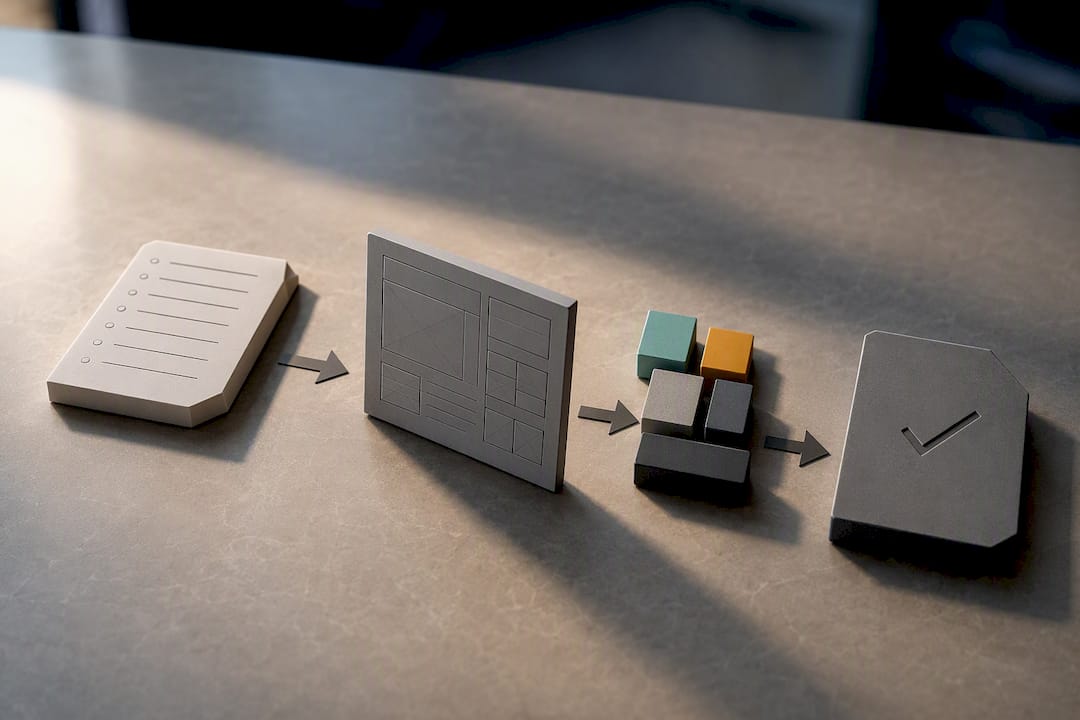
Buyers should insist on a written scope document, wireframes or a clickable prototype, and a fixed feature list as deliverables from this phase, not just a verbal walkthrough. Skipping it to save a few thousand dollars is the most common reason mid-size projects blow past their engineering allocation.
What Hidden Costs Should You Budget For?
The build price is never the whole story. Ongoing and one-off costs after launch routinely surprise first-time buyers, and they belong in your budget from day one, not discovered six months post-launch.
Annual maintenance typically runs 15% to 25% of the original build cost per year, per guidance from both Mobisoft and CodeStringers. This covers bug fixes, security patches, and minor updates, not new features.
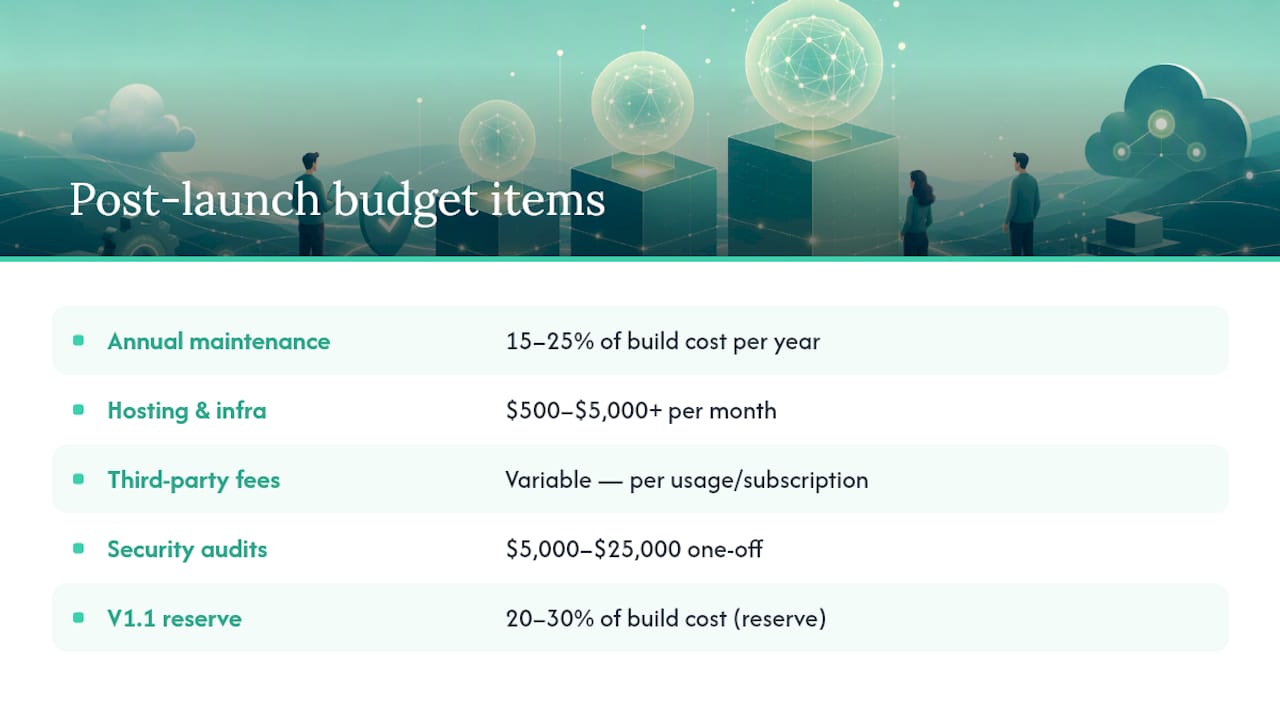
Hosting and infrastructure ranges from $500 to $5,000 or more per month depending on user volume, data storage, and whether you need redundancy across regions.
Third-party API and service fees add up fast: payment processors take a percentage of transactions, mapping or SMS services bill per call, and analytics tools often have their own subscription tiers.
Security audits and penetration testing for anything handling sensitive data typically cost $5,000 to $25,000, depending on scope.
On top of all that, CodeStringers recommends reserving 20% to 30% of the original build cost as a “V1.1” fund for the fixes and adjustments real users demand once the software is actually in their hands.
How Do You Get Accurate, Comparable Quotes?
Getting quotes that can actually be compared side by side takes more preparation than most buyers expect. Follow this sequence and you’ll avoid the two most expensive mistakes in software procurement: vague scope and no contingency.
- Pay for a discovery sprint first. Expect to spend $5,000 to $30,000 depending on complexity. Mobisoft’s research found that projects with disciplined discovery land within 10% to 15% of their original estimate, while skipped discovery often produces 30% to 60% overruns.
- Write a short brief before requesting bids. Include your feature list, required integrations, non-functional requirements (expected users, uptime needs), and acceptance criteria for “done.” Vendors quoting from the same brief give you comparable numbers.
- Add a contingency of 15% to 25% on top of any quote, and calculate a three-year total cost of ownership, build plus maintenance plus hosting plus third-party fees, before comparing custom development against an off-the-shelf or SaaS alternative. A tool like this ROI calculator guide walks through how to weigh software investment against ongoing value, which is a useful exercise even outside its original industry.
- Ask every vendor the same five questions: What’s included in this number? What’s excluded? What’s your change-request process? What does post-launch support cost? What happens if scope changes mid-build?
Pro Tip: Request quotes broken down by the phase shares above. If a vendor can’t show you where the engineering percentage sits relative to design and QA, that’s a proposal built backward from a target price rather than forward from actual scope.
Why Multiple Vetted Quotes Beat a Single Estimate
The biggest problem with custom software budgeting isn’t that ranges are wide, it’s that one quote tells you almost nothing about where you actually sit inside that range. A single vendor’s number reflects their staffing model, their region, and their sales incentives as much as your actual scope.
A marketplace platform exists to close that gap. Buyers post a project once and receive multiple tailored quotes from vetted developers, which turns a guessing game into a comparison exercise. Since developers on the platform go through a vetting process and buyers control who can contact them, the quotes that come back tend to be scoped responses rather than noisy cold outreach.
Use the spread across those five quotes as your real budget signal. If four quotes cluster near $90,000 and one comes in at $45,000, that outlier deserves scrutiny, not celebration. It’s also a fast way to test which team model, onshore, nearshore, or hybrid, actually fits your project before you commit.
— 5Quotes
Get Scoped Quotes Before You Commit a Budget
This service gets you real, comparable numbers faster than working the phone with individual agencies, because you write your brief once and vetted developers come to you instead of you chasing them down one by one.
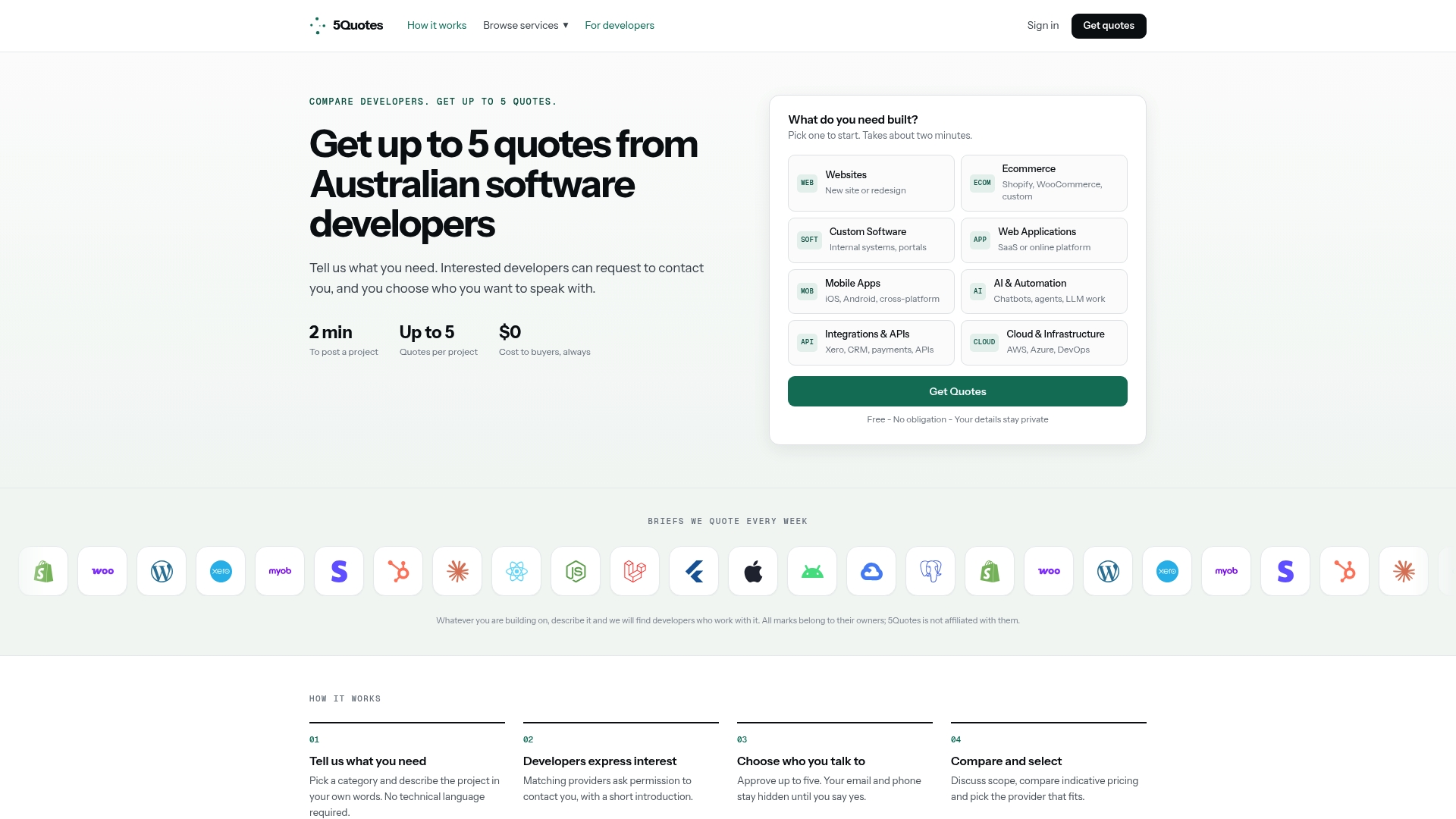
Start by writing a short brief covering your core features, required integrations, and any compliance needs. Then request up to five tailored quotes through the custom software development quote page and compare them phase by phase using the breakdown above, discovery, design, engineering, QA, and DevOps, rather than just the bottom-line total. If your project leans toward a web or mobile build specifically, the software development quote page walks you through the same process. None of this replaces a proper discovery sprint with your chosen vendor, but it does mean you walk into that discovery conversation already knowing what a realistic range looks like for your scope, not just what one salesperson told you.
Primary Sources for These Ranges
The cost bands and phase breakdowns in this guide draw on Clutch’s project pricing data for hourly rates and averages, Madgeek’s 2026 cost analysis for project-type ranges and integration costs, Mobisoft’s cost guide for phase splits and maintenance guidance, CodeStringers’ pricing breakdown for enterprise ranges and revision reserves, and Business for procurement and compliance context.
Sources
- Clutch — Developers pricing and project cost data
- Madgeek — Custom software development cost in 2026
- Mobisoft — Custom software development cost guide
- CodeStringers — How much does custom software cost?
- Business
FAQ
How much does custom software cost?
Small tools and MVPs run $15,000 to $80,000, mid-size business applications run $50,000 to $250,000, and enterprise platforms run $200,000 to $1.5 million or more, with Clutch reporting an industry average near $132,480 per verified project.
How much does custom software development cost in 2026?
Pricing bands haven’t shifted dramatically, but integration complexity and compliance requirements continue pushing mid-size and enterprise projects toward the higher end of their ranges, particularly where data migration or security audits are involved.
How much does it cost to have a custom app made?
A custom app typically falls into the same small-to-mid-size bands, $15,000 to $250,000, depending on feature count, integrations, and whether you need native mobile builds versus a single web application.
Can I create my own software?
You can build simple internal tools yourself with no-code or low-code platforms, but anything customer-facing, integrated with payment systems, or requiring compliance work generally needs professional developers to avoid costly rework later.
How do I get an accurate custom software quote?
Prepare a written brief with your feature list, integrations, and acceptance criteria, then request quotes from multiple vetted developers, using a service like 5Quotes to compare up to five scoped bids side by side rather than relying on a single estimate.
Recommended
Read next
Getting this built?
Tell us what you need and compare up to 5 quotes from developers who do this work.
Get quotes